
Monday, August 30, 2010
Horse park = perfect fit for Kittitas County
I'm pretty sure that, like me, most people who live in the lower county will be surprised to learn just how great a facility the new horse park near Cle Elum is. I wasn't able to go to the Northwest Shootout over the weekend, but I have had a tour. In addition to being extremely well-done, it's a classic example of a one-of-a-kind state facility located centrally here in Kittitas County.


Glenn Beck would vote for me
From FoxNews.com (3rd paragraph from end): "We should be looking for people with ideas. The country is in trouble and I don't see a political solution. I think both parties have sold their souls."
Friday, August 27, 2010
Farmers' Market Tomorrow

I'll be at the Ellensburg Farmers' Market with the last of this variety of peaches. Stop by for a sample and a chat!
Thursday, August 26, 2010
Board of Adjustment on way out?
Peach season is just about over (this weekend is when those in the know about getting really tree-ripe peaches will show up at the orchard), and I'll be more consistent about posting from here on out.
An article in yesterday's Daily Record tells us that the BoCC is thinking of replacing the 5-citizen Board of Adjustment with an attorney to rule on the various things the BoA rules on -- these are outlined in Section 15A.01.040.5 of the County Code.
Two points: (1) this is a really big change, and the BoCC should consider waiting to make a decision until after the new commissioner is sworn in following the election. The outgoing commissioner lost badly in the primary, apparently a reaction to his incompetence.
(2) More importantly, we need more citizen involvement in government, not less. The BoA's duties involve actually exercising judgement, not just making sure all the i's are dotted and the t's crossed in applications. The proposal reported in the paper mentions a Wenatchee attorney as the possible replacement for the citizen board, but the location of the replacement isn't the point.
Tuesday, August 17, 2010
Early primary results

We interrupt this issues-oriented blog with preliminary election results. The primary is turning out just about as I expected: Don Williamson and I are splitting the not-Obie vote; I have more votes than Don, so the general election will pit me against Obie. Campaigning with/against (however you say that) Don was a pleasure: he's a good and honorable man.
County-wide results are here, and state-wide results are here.
Photo: results as of 8 pm. There were about 1000 ballots left to count, so things could change.
We now return to regular programming: issues.
Big Solar in California on NPR
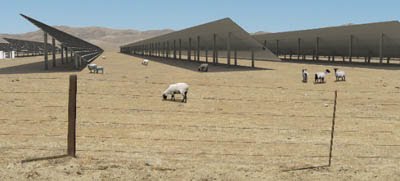
Here's a story on NPR this morning, about a very large solar project in the Central Valley of California. Very interesting; according to the story, projects must break ground by the end of the year in order to qualify for federal subsidies. There's a transcript and access to audio at the link.
Photo credit: artist's conception of the Panoche Valley solar project, from NPR story page.
Wednesday, August 11, 2010
TSR Approved
I've just come back from the Board of Adjustment meeting, which ran from 6 pm until after 10 -- I left just before the vote, which appeared to be heading toward approval. It's hard to distill over 4 hours of public meeting into a blog post, but here's a quick try.
It certainly is good that the Upper County will see some jobs during construction. It was refreshing to hear the contractor virtually promise lots of local jobs, after hearing wind farm companies at other meetings basically say that the wouldn't be hiring local people. As for long-term jobs, I have a hard time coming up with 35 job titles for a facility with no moving parts -- it's not like they'll be running three shifts. But I digress.
What I keep coming back to is the poor business case for the project. We're much too far north for reasonable solar energy production. It's a matter of cosmology and physics. What we're seeing is an unintended consequence of government incentives for renewable energy projects. In other kinds of business, if a company makes a mistake like siting a $300+ million project hundreds of miles north of where it should be, the company loses money. In this case, it's us (we?) taxpayers who will be paying for the poor location.
Tax and other incentives are a good tool, but I have seen so much abuse of them in the renewable energy industry that I have to wonder if they really are such a good tool, after all. I'll have to think about this. Meanwhile, on the bright side (no pun!), we can expect to see the Governor and at least one Senator visiting Kittitas County, and that'll be fun.
Tuesday, August 10, 2010
District 3

Note: this post is a bit of election housekeeping. If you're looking for the TSR posts, scroll down, or check out the Blog Archive at the left.
A number of you have contacted me, wondering why the primary ballot you got in the mail doesn't include the opportunity to vote for me. It turns out District 3, which is the area that votes for this County Commissioner seat in the primary, doesn't include as much of Ellensburg as many of us thought. It's especially confusing in the part of town shown on the map. It probably doesn't help that I have a few signs in District 1, but when people who live on busy streets ask, I give them a sign.
There's every reason to believe that you'll be able to vote for me in the general election, which will include the entire county. Meanwhile, you can still call or e-mail your District 3 friends and ask them to vote for me. Thanks for your support!
Sunday, August 8, 2010
TSR Summary II: Conditional Use Considerations

As we have seen in earlier posts, large renewable energy projects are conditional uses in agriculture-20, forest and range, commercial agriculture, and commercial forest zones. The TSR project claims to be the largest in the country, maybe the world, and would cover about 1.5 sections (1.5 square miles) in the eastern foothills of the Cascade Mountains of Washington with solar panels.
Once a project has been properly proposed, it's up to the Board of Adjustment (BoA) to consider and decide whether to allow the project to go forward. The relevant sections of the the County Code include 17.60A (Conditional Uses), especially 17.60A.010 and 17.60A.020, which are short enough to quote below (with a little editing for length; my paraphrasing is in [square brackets]). Chapter 17.96 describes the activities of the BoA itself.
Chapter 17.60A.010 Review Criteria.I'm guessing "desirable to the public convenience" is a term of art that means that a project should be beneficial to the county and/or its residents in some way. Likewise, in the Conditions section, conditions can be imposed to make a project more beneficial to the project area or the county as a whole.
The [BoA]...may permit and authorize a conditional use when the following requirements have been met:
1. The [BoA] shall determine that the proposed use is essential or desirable to the public convenience and not [dangerous, annoying or inconsistent with] the character of the surrounding neighborhood.
2. The [BoA] shall determine that the proposed use [will not cost the taxpayers too much, that there is enough infrastructure supporting the project, or that the proposer will supply needed infrastructure, or that it will generate enough economic return to taxpayers to offset costs.]
17.60A.020 Conditions.
1. In permitting such uses the [BoA] may impose in addition to the regulations specified herein, such conditions as it deems necessary to protect the best interests of the surrounding property or neighborhood or the county as a whole.
[2 and 3 aren't very relevant here]
So a conditional use project is supposed to be good for the county in some way, good enough to balance anything unpleasant about the project. Since change is painful, practically any project is going to bother someone, so every project had better have at least some benefits.
Here's where we run into one of the challenges of utility-scale renewable energy projects. In business-speak, these projects are high capex, low opex things. That means they cost a lot to build (capital expense), but don't cost much to operate (operating expense). What's more, most of the capital cost is paid outside the county, to manufacturers and to specialized construction crews that travel from job to job. So these projects don't translate into much in the way of jobs.
And here's also where we run into one of my pet peeves about renewable energy projects in Kittitas county and in Eastern Washington in general: out here is where the renewable energy is, and out here is where we get to live with the facilities that harvest the energy, but almost all of the benefits go somewhere else, especially when we're talking about out-of-county landowners.
That's all for now. I'm not going to presume to suggest how I think the BoA should proceed, but it has been helpful to me to think through these issues.
Photo credit: the Jumilla solar farm in Spain, at about 38.48° north latitude -- about the same latitude as Sacramento; Kittitas county is around 47°. It was the largest in the world, at 20 MW, in 2008.
Saturday, August 7, 2010
TSR Summary I: Conditional Use Application

The Teanaway Solar Reserve project highlights one of the challenges of development decisions in any county: what to do with projects that aren't really a good fit for the location, but which owners of the property want to do anyway? What if the project is a really bad fit?
My thinking on this issue took less research than the well moratorium issue (posted July 12), since I know a fair amount about renewable energy. I learned the most about zoning and the County Code as I consulted the following sources:
- A Kittitas County Office of Community Development official
- The Strategies 306 representative in Cle Elum
- A Cle Elum city official
- The websites and news items listed in my post on July 20
- The Kittitas County Code
One thing that is clear is that the site is not excellent, or even very good, for generating solar energy. According to a state solar map, the location receives 3.7-3.8 kW/m2 of solar energy. National solar maps show that there are many locations in the Southwest that receive more than 7 kW/m2. It's hard to find any locations in Washington that are competitive when it comes to solar energy, but here's one example, in Richland. It's in a location that receives 4.1-4.2 kW/m2, and it is a demonstration project, not a utility-scale project. The TSR location seems to have been chosen because it is convenient as a result of the relationships between the various players. Motives are important, but not necessarily relevant when it comes to land use decisions.
What is relevant is how a project relates to the County Code. In this case, the relevant part of the Code is mostly in Title 17 (Zoning), specifically 17.56 (Forest and Range Zone) which is the current zoning of the project site. The Purpose and Intent section of 17.56 says,
The purpose and intent of this zone is to provide for areas of Kittitas County wherein natural resource management is the highest priority and where the subdivision and development of lands for uses and activities incompatible with resource management are discouraged.I expect "resource management" in the Forest and Range Zone was intended to mean things like, well, forest and rangeland, not solar resources, which wouldn't have been part of the traditional understanding of the phrase back when this part of the Code was written.
For each zoning category, there is a list of uses that are allowed without asking the county's permission, and there is a list of uses that are "conditional," meaning the owner/developer needs to get a conditional use permit before proceeding. Although a major solar farm is very unlike any of the conditional uses listed in 17.56, a later section, 17.61 (Utilities) says that utility developments of various kinds are conditional uses in some zones; TSR is what's called a "major alternative energy facility." That means it's worth at least asking the county's permission to do the project.
Whew. It took a fair amount of writing and reading for us just to get to understanding that submitting a conditional use application is worth a try, but it's interesting to learn how all this works. Tune in next time for more on the application (the actual decision is up to the Board of Adjustment, of course).
Wednesday, August 4, 2010
Thanks, Professor Manweller...
...but we need to correct a few things about his piece in today's Daily Record. Of course I am flattered to have been mentioned in his column at all (I'll add a link to it as soon as I can find one). I am indeed the past leader of a short-lived local Move-On.org group.
Immediately after the "General Betray Us" incident I quit MoveOn. I spelled out the reasons why I quit in an e-mail that I copied as high in the organization's chain of command as I could. My e-mail said, in part,
Not long after, I had the following e-mail exchange with Professor Manweller, in which I offered to tell the local Republican Party about my concerns with MoveOn. Prof. Manweller's reply comes first, then my initial e-mail to him:
Immediately after the "General Betray Us" incident I quit MoveOn. I spelled out the reasons why I quit in an e-mail that I copied as high in the organization's chain of command as I could. My e-mail said, in part,
.... I'll spare you a long list of concerns, but I have lost confidence in MoveOn/OpDem's ability to lead on this issue. The childish "General Betray-us" ad was just one of several things that have caused this, and it came even after I had lost confidence.
Not long after, I had the following e-mail exchange with Professor Manweller, in which I offered to tell the local Republican Party about my concerns with MoveOn. Prof. Manweller's reply comes first, then my initial e-mail to him:
Subject: Re: Thanks and FYI
To: Steve Verhey
From: Mathew Manweller (manweller@)
Sent: Sat 9/22/07 7:11 PM
To: Steve Verhey (verheys@hotmail.com)
Steve,
Thanks for the email. Much appreciated. I think that one of the most significant barriers to a sucessful environmental movement is that people are often divided by process rather than goal. We all agree that a health environment is important, but we fight about how we shoudl achieve it. For me, the CLC is one of those groups that trancends this divide. It is voluntary and incentive based (so conservatives like me will sign on) but it pursues a traditionally liberal issue of environmental protection. If we could only find a "third way" for all the policy issues.
Would be very interested to hear your thoughts on MoveOn.org. and why you left. Let's chat more.
Thanks again for the nice email.
Matt
Subject: Thanks and FYI
To Mathew Manweller
From: verheys@hotmail.com
Sent: Sat 9/22/07 12:02 PM
To: Mathew Manweller (manweller@)
Hi Matt,
First, thanks for your performance at the CLC luncheon the other day. Very nice work for a good cause.
Second, it might interest you to know that I've left MoveOn/Operation Democracy. If you're looking for a speaker for a KC Republican Committee meeting one of these days, I'd be happy to explain why.
Best wishes,
Steve
Sunday, August 1, 2010
Peaches ready soon

I talked to a voter yesterday who wondered why it's been so long since I updated my blog. It's been a busy week, between campaigning, helping get the peaches ready for harvest (Verhey's Peaches, now with FaceBook page!), and helping Phil at the biodiesel plant.
I'm in charge of managing peach pest control. This year, probably because of the cool spring, insects seem to be less of a problem and fungal diseases seem to be more of a problem. The thunderstorms overnight Friday meant a trip to the farm the next day for fungicide spraying, but as I was filling the sprayer another thunderstorm came. (Note about fungicides, and pesticides in general: over the past few years some great chemicals have become available -- now we have options that include organic-certified and zero-reentry and zero-preharvest products, which is what we use now.)
Saturday, July 24, 2010
TSR Update

On August 11 the Board of Adjustment will meet to hear public comments on the TSR conditional use permit. Later, probably this summer but maybe in the fall, the board will vote on whether to issue the permit. I'm a little surprised at the lack of news and discussion about this project, given how various wind projects were received.
This past week I visited with a cognizant official at the County Planning Department and with various citizens, who helped me understand the process. I continue to be impressed with the professionalism of county staff. Meanwhile, I have yet to find any citizens who support the project.
We all have mixed feelings about wind power projects (and I don't think any of us like the way the Kittitas Wind Project looks), but at least the wind does blow here, more than almost any other place in Washington, and not much less than the best wind power locations in the country. The same is just not true for solar energy: Kittitas county -- the entire Northwest, really -- is not competitive when it comes to megawatt solar photovoltaic potential.
Map sources: Washington solar (top), US solar (middle), Washington wind plus transmission lines (bottom).


Please dial back the rhetoric
There's no excuse for the language that's being used in the comments section of the Daily Record's article about the first candidate's forum. Please keep things civil.
Tuesday, July 20, 2010
TSR sources of information
Here are some sites worth looking at (thanks to Julie for thecart.org).
I do want to make it clear that I'm starting this research process with an open mind, and I'm equally prepared to find that the project is worthwhile, or in the wrong place, or that I need more information.
TSR's Facebook page-- Not a great source of information, but they do seem to post news updates fairly regularly. The site is about 4 miles east of Cle Elum, not north as the FB page says.
For a little while TSR had a blog, but then migrated the blog to their current project web page. The web site includes a "fact vs. fiction" page.
Seattle Times article, Feb. 1, 2010: "Proposed solar power plant tangled in many messy questions." I'm going to have to read this one a couple of times.
Forbes.com's report on the DNS determination.
Strategies 360, the strategic positioning (I think that means "PR") firm that seems to be handling everything related to the project. That the project was mentioned by Forbes indicates that S360 knows what they're doing.
A February announcement by TSR said that Potelco, a Sumner, WA utility contractor would be a "contractor and equity partner." FWIW, Potelco is also a client of S360 and is a subsidiary of Houston-based Quanta Services Inc., which has the enviable ticker symbol of PWR. Renewable Energy Corporation, a solar panel/system manufacturer in Moses Lake, is also a S360 client.
There appear to be two Facebook pages of groups expressing concern about TSR: Friends of the Teanaway River Valley and Citizens for a Rural Teanaway.
Citizens for a Rural Teanaway also has a very informative website where I'll be spending more time. Near the top of the page is a suggestion that the project is more suited for sagebrush country because of sagebrush's supposed inferior aesthetics compared to trees. As a person who grew up in sagebrush country, I happen to think sagebrush is beautiful, and dense trees kind of creep me out.
A January 27, 2010 Daily Record article about the Cle Elum City Council's concerns about the project.
Stay tuned....
Sunday, July 18, 2010
Teanaway Solar Reserve

The Teanaway Solar Reserve project will be in the news off and on for the next few weeks, as the county Department of Community Services has issued a mitigated determination of nonsignificance for the project (July 16 Daily Record article, Kittitas County Community Development page. As I wrote earlier, it seems to me that a project of this size and uniqueness in the area deserves a closer look, but that's not necessarily the way State Environmental Policy Act works (RCW 43.21C.030).
This is an interesting topic for several reasons. The county's mishandling of the well moratorium has led to an unusually difficult economy in the Upper County, and the project promises jobs, at least during the construction phase. On the other hand, there appears to be strong opposition to the project among many Upper County residents.
Over the next week or so I'll be taking a closer look at the project, and talking to various stakeholders in the same way I analyzed the well moratorium issue.
Monday, July 12, 2010
Well moratorium summary

One year ago this week the Department of Ecology imposed a moratorium on well drilling in Upper Kittitas County.
Being an independent, there's no one to tell me what to think about this (or any other) issue, and I don't have any financial interest or ideological bias, so I've had the opportunity to do my own research and reach my own conclusions. In my research, some of which I have mentioned earlier in this blog, I've talked to, among others:
a County Commissioner, a well driller, a founder of Aqua Permanente (the organization that initially brought the issue of exempt wells to the attention of the Department of Ecology), the superintendent of one of the two water companies of which my property is a member, owners of property directly affected by the moratorium, construction workers unemployed as a result of the building slowdown in the Upper County.
I've also attended public meetings about the issue, gone to a state employment/ economics conference, and read many -- but by no means all -- of the newspaper articles about it. And, of course, I've read as much of the relevant state code (RCW) as possible. I've used all this information in my thinking about the causes and effects of the moratorium, and about how the situation might have been handled differently.
Briefly, my conclusion is that the well moratorium didn't need to happen, and I certainly would have handled the situation differently and in a way that preserved jobs as much as possible.
The issue isn't as complicated as it sounds, but there is a lot to explain. Explaining how I reached this conclusion will take some space, so I'll continue on a different page. Please read the entire post first if you decide to comment below.
Saturday, July 10, 2010
Employment situation and outlook
Yesterday I went to the Central Washington 2010 Economic Symposium in Yakima and, interestingly, it gave me still more insight into how we got into the Upper County well moratorium mess, as well as into the entire employment situation in Kittitas County.
One strong message was that the economy has drastically changed compared to where it was 5 years ago, and the way forward will be very different from the recent past. Kittitas County is worse off than other Central Washington counties in some ways, and better off in other ways. As you might expect, the overall effect was both sobering and encouraging, with some clues about how to go about strengthening Kittitas County's economy.
One strong message was that the economy has drastically changed compared to where it was 5 years ago, and the way forward will be very different from the recent past. Kittitas County is worse off than other Central Washington counties in some ways, and better off in other ways. As you might expect, the overall effect was both sobering and encouraging, with some clues about how to go about strengthening Kittitas County's economy.
Thursday, July 8, 2010
Ecology meeting with BoCC
Yesterday, continuing my research on the upper county well moratorium, I went to the meeting between the Board of County Commissioners and Tom Tebb, Director of the Department of Ecology's Yakima office. On the phone from Olympia was Ecology's attorney.
Everyone seemed to be on their best behavior. I was interested in the tone of the meeting, since the primary election is coming up, and some of the commissioners (especially Mark McClain) have been quoted as having said some fairly intemperate things about this issue.
The takehome message of the meeting was basically the same as the Daily Record's editorial yesterday: don't spend any money on building unless you have legal access (in addition to practical access) to water.
Action by the county in the past weeks had complicated the situation, but no one wants a homeowner to have spent money on construction only to find they can't have the water they need. Here's Ecology's web page, "How to Request Water Budget Neutral Determination."
Sunday, July 4, 2010
Teanaway Solar Reserve

One issue that awaiting the new county commissioner is the Teanaway Solar Reserve project, located, according to the project's FaceBook page, 4 miles north of Cle Elum. Here's a fairly comprehensive Yakima Herald-Republic story from October 31, 2009.
The project is controversial because the Cle Elum area could really use more jobs, but the project site is in the Teanaway River area, which is currently only very lightly developed.
I regularly do work as a renewable energy consultant, although I don't do professional work on solar photovoltaic (PV) projects. I'm still learning about this project, and I'm sure I'll be writing more about it, but here's some information to start with.
As shown on the map* above, the TSR site receives less solar radiation than the Puget Sound Energy solar site at Wildhorse. PSE has reportedly decided not to expand the Wildhorse solar project, even though the existing solar panels are already connected to the grid, and the Wildhorse site receives a considerably lower amount of annual precipitation than the TSR area.
Some areas in south-central Washington are reasonably promising for solar PV projects, but, really, most of the action in the U.S. is much farther south.
The next step -- due to be taken this summer -- in the process of considering this project is determining whether an environmental impact statement (EIS) will be required. Since the project is being billed as "the largest in the Northwest" (TSR website) and "one of the world's largest" (Yakima Herald-Republic story), it seems pretty obvious that it is unusual, and that strongly suggests that an EIS should be done. Come to think of it, locating a large solar PV project in the forested mountains is probably not something that has ever been done before, anywhere. Clearly special care is needed in considering how to proceed.
*Click here for map source.
Saturday, July 3, 2010
Parade in Cle Elum
I made a point of talking to a number of voters at the 4th of July parade in Cle Elum today. The economy, water, and development in the Teanaway area were the most common topics. One person told me that he has been directly affected by the moratorium, as he has property he's trying to sell but which doesn't have water at the moment. He felt pretty strongly that the County Commissioners didn't try hard enough to avoid the moratorium.
Thursday, July 1, 2010
Talking to a well driller
Inspired by my visit last week with Commissioner Jewell, I have been working on understanding how the upper county well moratorium mess happened, looking for insights on where to go from here. Everyone does agree that it's a mess, and the effect it has had on the economy is unfortunate at best, tragic in places at worst.
While spending a few hours reading old newspaper reports about the run-up to the moratorium, I noticed that the name of Jeremy Bach (Bach Drilling has been in the water well drilling business since 1894, and in Kittitas county since 1943) kept coming up. So I gave him a call to see what he had to say.
Like Commissioner Jewell, Mr. Bach was very gracious and generous with his time, and helped me toward understanding how we got here. Of course -- and I don't think Mr. Bach would mind my pointing this out -- he is in the well drilling business, so it would be unfair to expect him to be neutral on the issue. Still, he has a wealth of knowledge about wells and water, and he has been involved in the process for quite some time. After our conversation he suggested I take a look at the issues section of his web page, too.
Saturday, June 26, 2010
Meeting with Commissioner Jewell
 I had a good visit with Commissioner Jewell, who was very generous with his time. We talked about the community wind ordinance, and as a result I have edited my earlier post on that topic.
I had been prepared to limit the conversation to the community wind issue, but Commissioner Jewell brought up a couple of other important issues on his own.
We talked about the upper county well moratorium, and he helped fill in some of the blanks in my understanding of how we got to where we are. If only there were a way to take all the mental energy - - on all sides -- that's gone into that issue, and use it to generate electricity! Anyway, I'll write more about this later.
He noted that there have been past abuses of real estate development codes, but that those abuses happened before his time, and, he said, they are no longer happening. He agreed that the past abuses still reverberate, and that they are influencing some things that are happening now.
Wednesday, June 23, 2010
Saturday, June 19, 2010
More on community wind
As reported in today's Daily Record, Cascade Community Wind Company is asking the Board of County Commissioners to reconsider their unanimous decision against individually owned commercial-scale wind turbines. I don't think the BoCC should reconsider, but I do think the issue could have been handled better.
Here's what happened: the county was approached with an idea by a group of local farmers and by an engineering firm from Bellingham. Over the course of a year-and-a-half the county held who-knows-how-many meetings, all of which were attended by local farmers and a company engineer who drove almost 4 hours one-way each time. In the end, not even the commissioner who organized and led the open houses and public hearings voted for the proposal.
Let's say the engineer made a dozen trips, and ignore the time local people invested. That means he spent a hundred hours just driving to meetings. Of course, he viewed his time as a worthwhile investment, because he expected there was a reasonable chance that if he did a good job, all his effort would pay off. That's how business works.
Being in business is about managing risk, but being led on by the county isn't a risk anyone should have to accept.
I followed the community wind ordinance process, and went to two of the public meetings, plus the final one where the vote was taken. It seemed all along that the county wasn't putting much effort into making the ordinance work -- it had an unfinished feel to it, and it had some strange parts. For example, it would have allowed lattice wind towers. At one meeting I commented on this, saying I thought it was a bad idea.
Lattice towers were still allowed in the final ordinance -- and were cited by Commissioner Jewell as a reason he voted against it. Apparently the proponents of the ordinance wanted flexibility in tower design.
It doesn't matter if you were for or against the proposal, we should all care if and when the valuable time of so many people -- not to mention taxpayers' money -- is wasted by a process. Those in favor of the ordinance seem to have made a good faith effort, and the final ordinance largely reflected their wishes.
Virtually no significant new business development can happen in this county without the Board of County Commissioners' say-so. Any new business is going to look at what happened here and think twice about bothering to jump through the hoops. There are plenty of other places to locate business without having to play risky games with the BoCC.
Is Kittitas County open for business? It sure doesn't look like it.
Friday, June 18, 2010
A surprise contribution
Today a person who I knew, but who I didn't know knew me, handed me a check for $50. I was somewhat astonished. He said, "it can't get any worse." I'm sure he meant that in the nicest possible way.
Thursday, June 17, 2010
WSU and higher education
Last night I went to the reception for and presentation by Elson Floyd, President of WSU. A very impressive man, Dr. Floyd. A couple of highlights:
 He started by showing a brief video about WSU, including how WSU research helps Washington agriculture -- and the very first feature was the mint composting project I did when I was at CWU! It was fun to see my old friend and WSU colleague Lynne Carpenter-Boggs on the screen.
Lynne (that's her in the picture, on the Scarab compost turner) and I were really proud of that project, which took a crop residue that was a huge liability and turned it into a multi-million dollar business over on the west end of Royal Slope. It's an excellent example of how CWU and WSU can and do contribute to our local economy and especially to agriculture.
Many of us were concerned last year that budget cuts at WSU would affect Extension programs in Kittitas County, but Dr. Floyd assured the crowd that that was not and will not be the case. (Here's how it works now: WSU pays the salaries of two Extension Educators, and Kittitas County pays their benefits and also pays for the staff and office facilities. The Kittitas County part of the budget is a little under $200,000, and this is obviously a good deal for the county. In return we get 4H information and education for local farming and ranching, among other things.)
Dr. Floyd talked about the budget cuts he's had to make at WSU, amounting to over 10% of the university's budget, and how in some ways the cuts have made the university better. But another round of similar cuts would be disastrous, he said.
Although he didn't draw the connection himself, Ellensburg and CWU have a relationship that's similar to the one between Pullman and WSU. The next round of cuts, if it comes and is large, will involve many peoples' jobs. In many cases at each university, both spouses of families work at the university. If one spouse loses his or her job, the entire family would probably be forced to move, and would have to sell their house at what would be a very bad time for house-selling.
Wednesday, June 16, 2010
Barbara Newman had a rather flattering letter about me in the paper yesterday, also with comments about my opponent, Obie O'Brien. It made me cringe a little to read such blunt language about Obie, but I have to admit that I don't actually know him. Barbara has been working as a citizen on the issues she mentions (urban planning, quality of life) for a number of years, and so should know about Obie's policy views in those areas.
Monday, June 14, 2010
More Barbecue! Mountains to Sound Greenway

I had a chance to go to another barbecue, at a meeting of the Mountains to Sound Greenway organization in Cle Elum. This one featured Glondo's sausages, which were extremely juicy and delicious. Excellent turnout of about 35 people, including a number from Vision Cle Elum.
Mountains to Sound turns out to be almost 20 years old, and they're getting ready for their 20th year by taking a look at the entire area between the Seattle waterfront and Ellensburg, collecting ideas and thoughts about what's important from people and groups all along the way. I had only read about the organization before, so I'm glad I went. They've been involved in bringing together individuals, businesses, farmers, timber companies, and many others to develop things ranging from open space and recreational trails to gravel pits and condos. Seems like a good group.
They're having a series of meetings about their Heritage Study project through the summer, all at the Ranger Station in Cle Elum, to meet people and collect information (click on the map to download a large version).
Friday, June 11, 2010
It's Official
I formally declared my candidacy today, using money instead of signatures. Let 'er buck!
Subscribe to:
Posts (Atom)